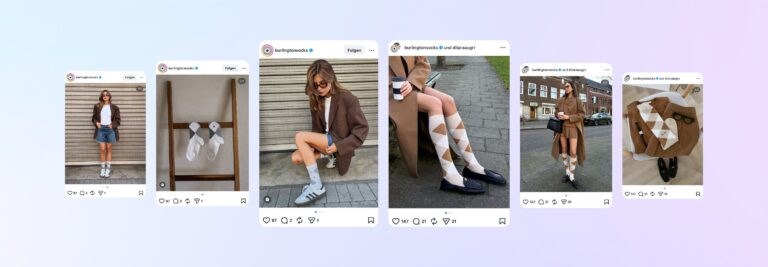
A user lands on your product page. They like the product. They still click away.
What’s usually missing isn’t the price or the description — it’s the context. How does that jacket look on an actual person? How does that sofa work in a living room that didn’t come straight out of a catalogue?
This is where the inspiration gap opens up: between the content that draws users in on social media and brings them to your shop, and the commerce moment in the shop where the purchase decision is actually made.
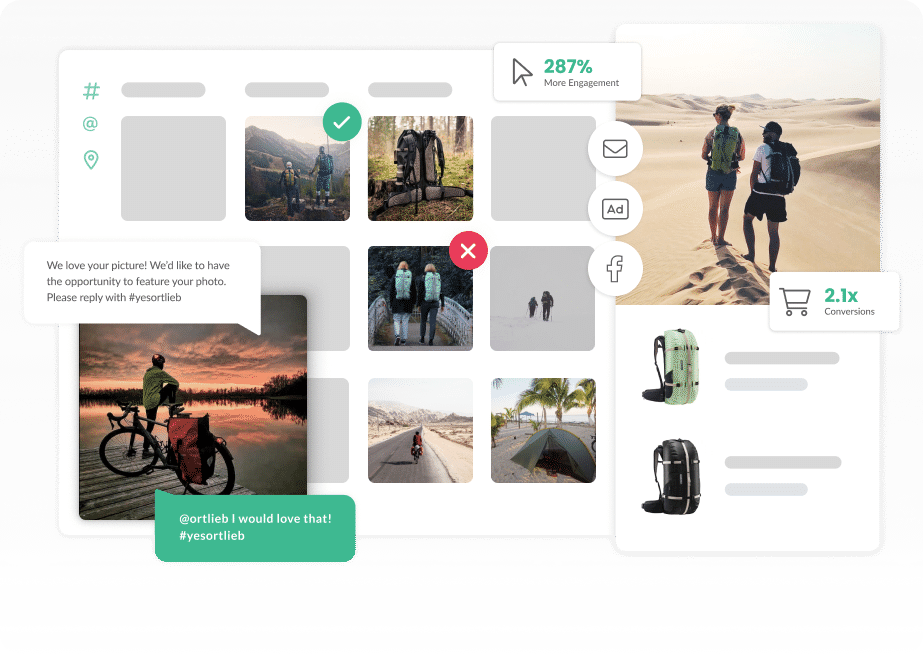
Traditionally, these two worlds are separate. On Instagram, you’ll mostly find inspiration and content from the community. In the shop, you’ll mostly find styled product photography. If you embed community content into your shop pages systematically, you bridge the two — instead of letting it pile up in content folders. For the underlying argument on why this shift is no longer optional, see Why social commerce isn’t a trend.
Why social proof works psychologically
Social proof isn’t a marketing trick. Robert Cialdini described the mechanism decades ago: people take their cues from what others do, especially under uncertainty. Creator content sends exactly that signal: Other people are buying this. It’s safe. For a deeper take, see our piece on Social Proof in E-Commerce.
But social proof alone doesn’t explain why creator content often outperforms highly polished brand shots. Two more effects amplify the impact:
Cognitive ease. The brain prefers impressions it can process without effort — a concept Daniel Kahneman put on the map in Thinking, Fast and Slow. An image from a real home with a real person is easier to “read” than a studio shot. Less cognitive friction — more trust.
Implicit egoism. We respond more strongly to people and contexts that resemble us. When a creator looks, lives, or speaks like the target audience, identification happens automatically. Brand content rarely manages that; community content almost always does. Why authenticity doesn’t beat polish by accident is something we covered in AI content vs. human-first.
According to the Nielsen Trust in Advertising Study 2021, 88% of consumers globally trust recommendations from people they know more than any other form of advertising — no other channel comes close. In parallel, McKinsey’s “Next in Personalization” reports that 91% of shoppers expect personalisation and authentic recommendations. That’s exactly what community content delivers.
Three ways to scale inspiration on your shop page
For all the theory, what really matters is the execution. The key question is how the content is embedded into the e-commerce experience to actually move the needle. squarelovin’s Shop The Look distinguishes between three different types of streams.
1. The teaser on the homepage
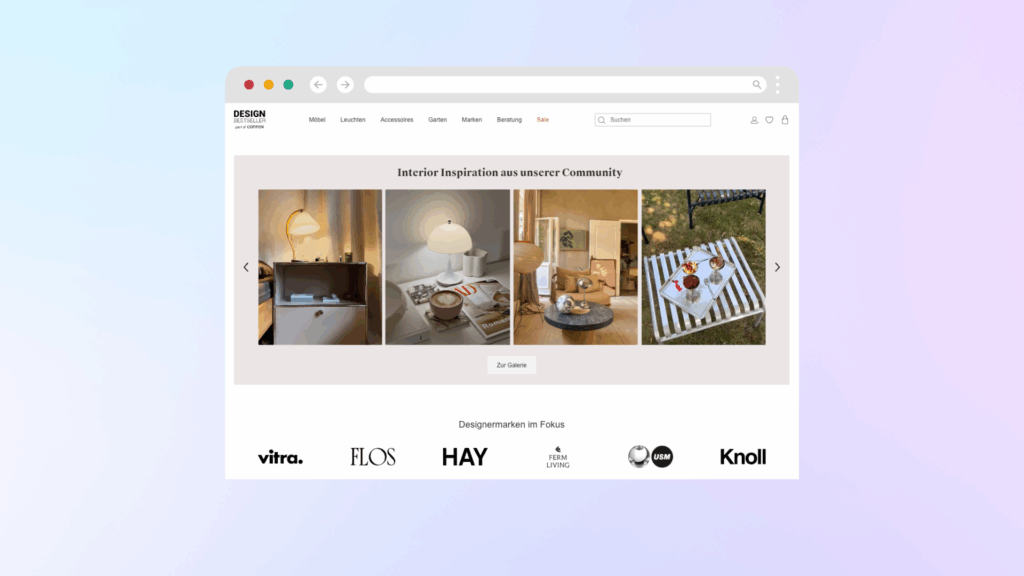
- Shop The Look teasers are small, subtle preview elements placed directly on the homepage of a shop. Users see a trust element at first glance — products in a real-life context, not glossy product photography, not stock imagery.
- The benefit for shop owners: Shop The Look streams are eye-catchers that hold users in the shop. squarelovin teaser integrations measurably reduce bounce rates — and at the same time, the implementation is efficient enough that the dynamic content doesn’t slow down page load.
2. The full-page stream
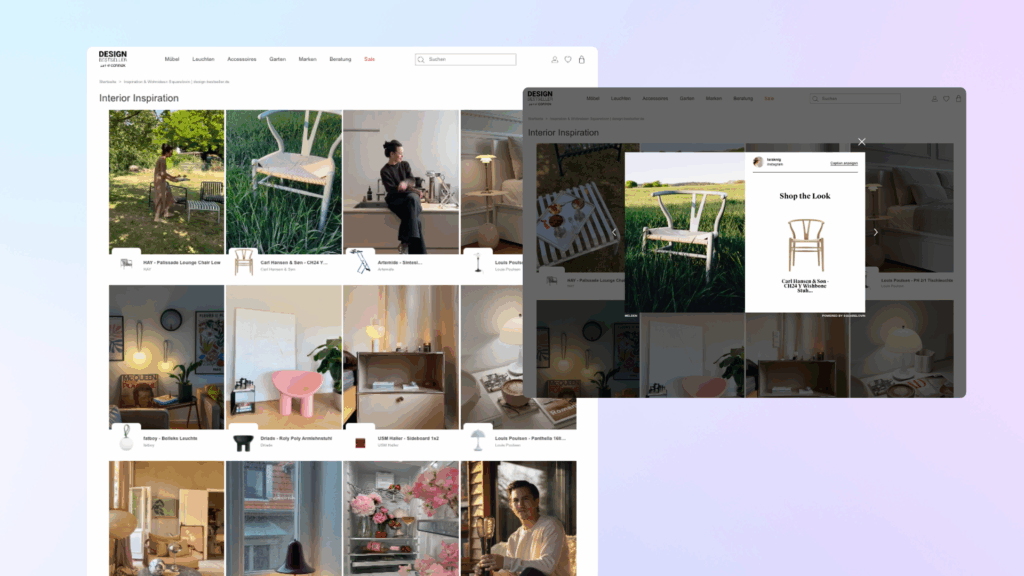
A dedicated landing page with infinity scroll and a Pinterest-style logic — typically titled “Community Gallery”, “Shop our Instagram”, or under the brand’s own hashtag. Whoever lands here is no longer in search mode but in inspiration mode: scrolling further, comparing looks, discovering new products.
- A classic shop touchpoint becomes a discovery surface that holds attention noticeably longer than any category page — and stays inside the brand’s world, because it’s fed by real community content.
- The benefit for shop owners: Full-page streams invite scrolling. Users who interact with them click through several assets and spend significantly more time on the page than the average visitor.
- With direct product links inside the integrated pop-ups, product views climb noticeably too. On top of that, the stream pulls additional organic traffic on inspiration-driven keywords.
3. The product page stream
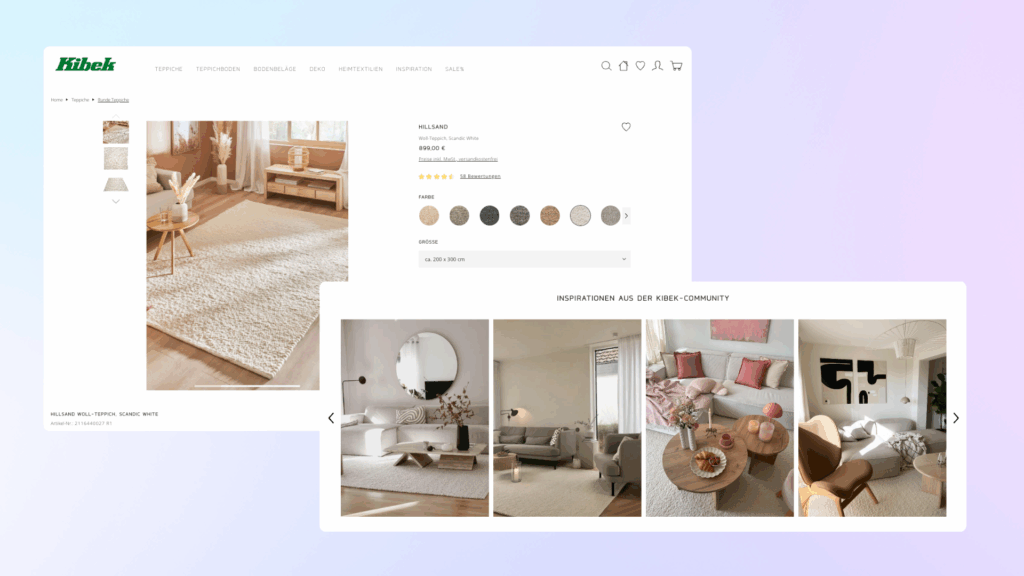
On the product detail page, a filtered stream shows community content related only to that specific item. Anyone seriously evaluating a product gets a layered set of real-life uses, looks worn in real settings, and actual home environments on the same screen — exactly the input that usually sits missing between interest and purchase.
- The benefit for shop owners: a conversion lever on the highest-revenue page of the shop — and the one community-content touchpoint where performance can be attributed per asset.
How Schöffel and Design Bestseller turn social proof into conversion
Visual content alone isn’t the lever. The difference comes from linking it to the product catalogue.
When a user clicks an asset in the stream, a pop-up opens. Product tagging links the items shown in the image directly — from the look to the cart in two clicks, with no break between inspiration and search.
Best practice: Schöffel
Schöffel runs Shop the Look directly on the homepage — under the title #ichbinraus, the hashtag the brand’s own community uses to mark its outdoor moments on social media. Exactly that content flows back into the shop at this point: real shots, real people outdoors in Schöffel gear, instead of a classic hero slider.

When a user clicks on an image or video, the pop-up opens with the user name, the original caption, and the product worn in the image. Two clicks later, the item is in the cart — without the user ever leaving inspiration mode.
The hashtag here is more than a label: it closes the loop from community signal to shop asset and turns every post into a potential sales argument.
Best practice: Design Bestseller
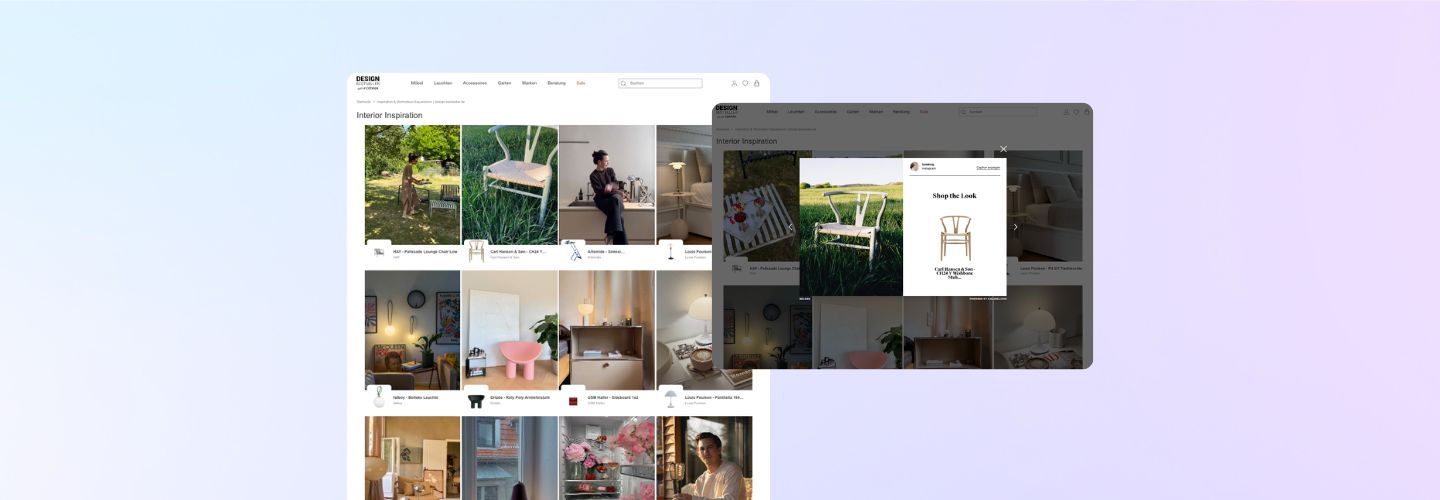
Design Bestseller takes it one step further and runs all three of the above formats in parallel. On the homepage, a Shop The Look teaser displays photos and videos from the community — each with direct product links, so an inspiring living-room shot becomes a two-click pendant-lamp purchase. The teaser also routes through to the full-page stream.
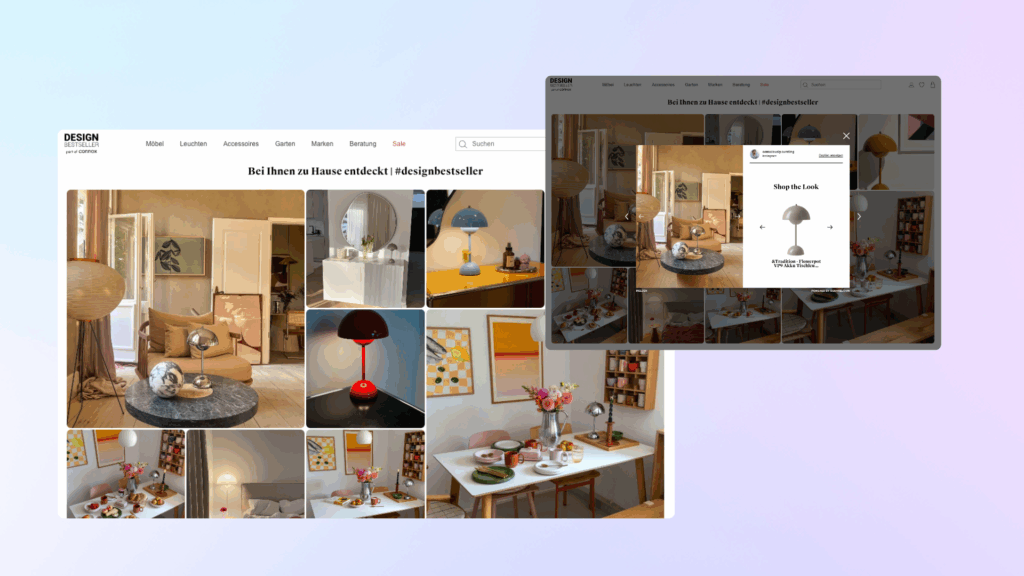
A dedicated landing page called “Interior Inspiration” rounds out the experience with a full-page Pinterest-style integration, where users can scroll through real interior setups from the community — every piece of furniture, every lamp, every accessory directly shoppable.
The third lever sits on the product detail pages. Right below the product and its description, a dedicated stream titled “Bei Ihnen zu Hause entdeckt | #designbestseller” (“Spotted in your home”) runs in the same board layout, but filtered to community shots of that specific item. Anyone who scrolls that far has the last small argument right there in the image — social proof exactly where doubt usually leads to an exit.
And the numbers back it up: +8% conversion rate through the on-site widgets and +15% time on site. The content pulls its weight outside the shop too: at Design Bestseller, social ads featuring community content reach a 5% higher CTR than classic product photography. Social proof here isn’t a branding vibe — it’s its own performance channel with its own reporting line.
Conclusion: social proof is a performance channel
Community content stopped being a “nice-to-have” a long time ago, and it’s no longer a branding-only topic either. Integrated properly, it’s a measurable performance lever for the online shop — on par with paid ads, only with much stronger trust-building behind it.
What the intro framed as the inspiration gap is, at its core, a timing problem. Cognitive ease, implicit egoism, and social proof only kick in when the right visual anchor shows up at the right point in the customer journey.
That’s exactly what the three Shop The Look integrations address: the homepage at the discovery moment, the full-page stream during the inspiration phase, and the product detail page right before the purchase decision. The lever lies less in the content itself — and more in placing it consistently at the touchpoints where purchase decisions are actually made.