
There’s a paradox playing out in social media marketing right now.
Every major platform — Meta, YouTube, TikTok — is doubling down on AI content tools, making it faster and cheaper than ever to produce content at scale. And yet, new data shows that the very content these tools produce is eroding the trust of the audiences brands are trying to reach.
The Sprout Social State of Social Media 2026 report, based on a survey of over 2,000 social media users in the US, UK, and Australia, puts a number on what many marketers have been sensing intuitively: the more AI-generated content floods the feed, the less audiences trust what they see.
For brands willing to read the data correctly, this isn’t a crisis. It’s the core argument for human-first content marketing — and one of the biggest opportunities the industry has seen in years.
The Data: What Users Actually Think About AI Content in 2026
The Sprout Social Q1 2026 Pulse Survey paints a clear picture of how trust, news consumption, and brand expectations are shifting. The findings are worth sitting with.
Social media has officially overtaken TV as the #1 news source.
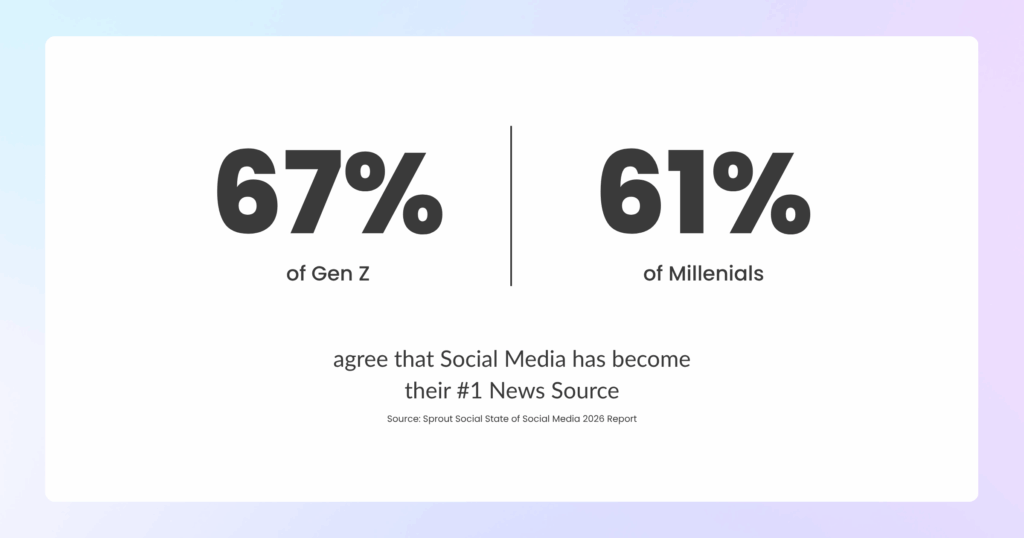
For the first time, social media platforms rank above television as the primary source of current information. 67% of Gen Z and 61% of Millennials now turn to social platforms for news. The most-used channels: Facebook, Instagram, YouTube, and Reddit.
This shift has enormous implications for brands. Social media is no longer just a marketing channel — it’s where audiences form their worldview. The content that appears in those feeds doesn’t just drive awareness. It shapes perception, builds or destroys credibility, and influences decisions at every level of the funnel.
But trust is under serious pressure.
88% of survey respondents say that AI-generated videos have weakened their trust in news on social media. That’s not a marginal finding. That’s nearly nine out of ten users actively pulling back from content that feels generated.
The trust killers are clear: misinformation (30%) and uncontrolled AI content (20%) top the list.
The nuance most brands miss: overall platform trust is more stable than you’d expect.
Despite the headline numbers, audiences aren’t abandoning social media altogether. For 49% of users, trust levels have stayed the same compared to last year. For 16%, trust has actually increased.
The real insight: users aren’t leaving the platforms. They’re becoming more discerning about what they trust within them. And AI-generated content is sitting at the bottom of that trust hierarchy — while human-authored content is becoming increasingly rare and valuable.
Why This Is Happening: The AI Content Fatigue Effect
To understand the opportunity, you need to understand the problem.
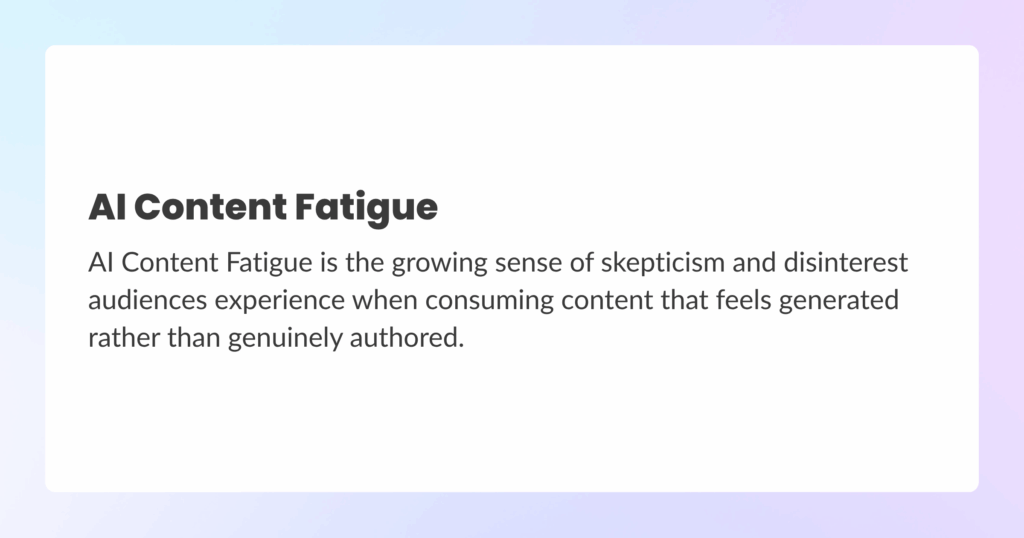
AI Content Fatigue is the growing sense of skepticism audiences experience when consuming content that feels generated rather than genuinely authored. It’s not purely a quality issue — it’s about authenticity signals.
Humans are remarkably good at detecting inauthenticity, even when they can’t articulate exactly why something feels “off.” A post that lacks a specific point of view. A caption that’s technically correct but emotionally flat. A perspective that could belong to any brand, anywhere. These are the subtle signals that trigger disengagement and distrust.
And audiences are getting better at reading them every single day.
The volume problem accelerates this effect. As AI tools make content production faster and cheaper, the average quality of content in any given feed drops. The signal-to-noise ratio declines. Audiences develop what might be called a content immune system — a heightened sensitivity to anything that doesn’t feel genuinely human-driven.
It’s worth being precise here: this is not an anti-AI argument. Artificial intelligence is a legitimate and powerful tool for efficiency, research, ideation, repurposing, and production support. The distinction that matters is between using AI as a tool and outsourcing your brand voice to it entirely. One makes you faster. The other makes you forgettable.
The Opportunity: Why the Trust Gap Is Good News for Smart Brands
Here’s the paradox worth paying attention to: as AI-generated content becomes more abundant, human-created content becomes more scarce — and therefore more valuable.
Basic economics applies. When supply increases and trust decreases simultaneously, the premium shifts to authenticity.
Brands that have built a recognizably human voice — content that reflects a real perspective, a genuine personality, an actual point of view — stand out not despite the AI content boom, but because of it. In a feed full of generated noise, a brand that sounds like a real person with real opinions becomes immediately distinguishable.
This is the moat. And right now, most brands aren’t building it.
The window to establish this differentiation is open — but it won’t stay open indefinitely. As more brands recognize the trust gap and begin investing in authentic content strategies, the competitive advantage will narrow. The brands moving now are the ones who will own the positioning.
What “Human-First Content Marketing” Actually Means in Practice
Human-first content marketing isn’t about avoiding AI — it’s about ensuring that the human perspective remains the primary driver of what gets created and published. Here’s what that looks like in practice:
- Real perspectives over generated opinions: Thought leadership that reflects genuine expertise, experience, and point of view. Not content that could have been written by anyone — or anything. This means investing in the people behind the brand: giving them a platform, a voice, and the space to say something that has actual edges. Generic takes don’t build trust. Specific, sometimes uncomfortable opinions do.
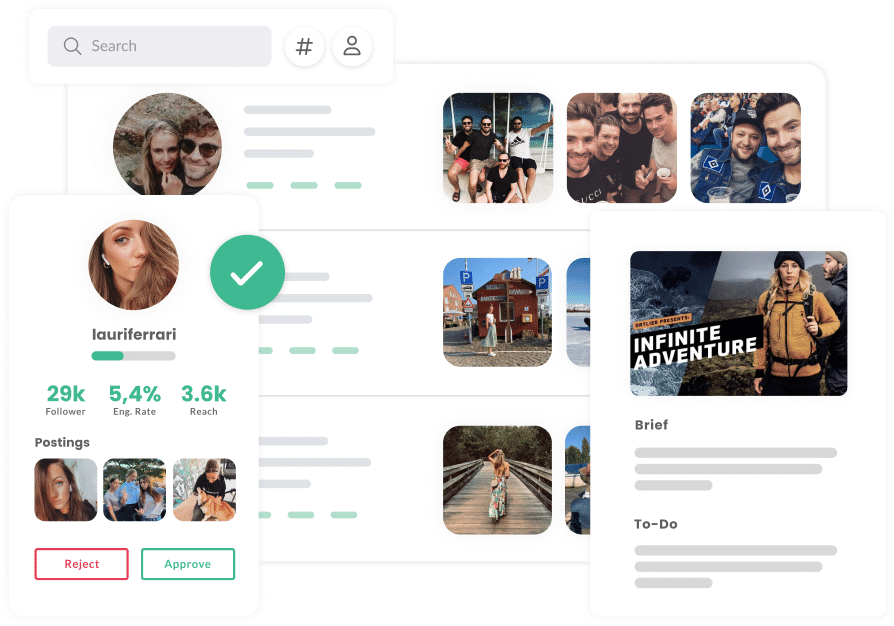
- Creator partnerships with authentic brand fit: Influencer and creator marketing that prioritizes genuine alignment over reach metrics. An audience can tell when a creator actually uses and believes in a product — and when they’re reading from a script. The brands that win in creator partnerships are the ones that select for authenticity first and let performance follow, rather than optimizing for follower counts and hoping trust comes with it. Learn more about how to discover creators with a high brand fit in our blogpost on the topic.
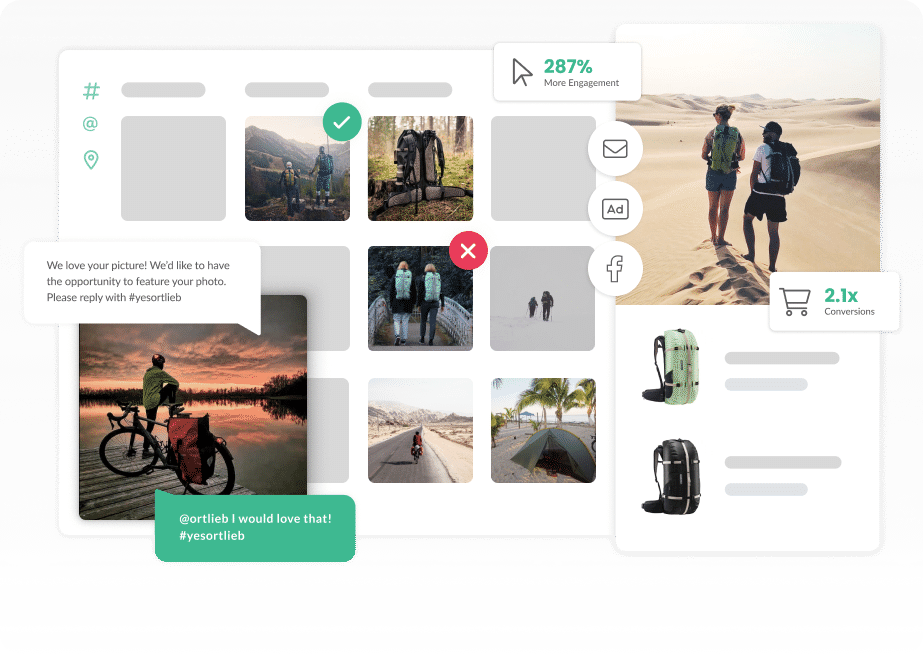
- Community-driven content: Treating your audience as a content partner, not just a target. User-generated content, community spotlights, real customer stories — these formats perform precisely because they are human by definition. They can’t be fully faked, and audiences know it. Investing in the infrastructure to surface and amplify these voices is one of the highest-leverage content strategies available right now.
- Transparency about process and values: Brands that show who they are — not just what they sell — build trust at the identity level. Behind-the-scenes content, honest communication about decisions and challenges, and consistent behavior across all touchpoints contribute to the kind of brand recognition that creates long-term loyalty. Audiences don’t expect perfection. They expect authenticity.
- Consistent brand voice across all channels: Consistency is itself an authenticity signal. When a brand sounds like itself across Instagram, online-shop, email, and any other form of customer interactions, it signals that there’s a genuine identity behind the content — not just a different AI prompt optimized for each channel. One way to achieve this is to integrate community and creator content along the entire customer journey.
What This Means for Your Social Media Strategy in 2026
The data points to a clear strategic direction. Here’s how to act on it.
- Audit your current content for authenticity signals. Look at your last 30 posts and ask honestly: does this sound like us? Does it reflect a specific point of view? Would a reader recognize this as our brand without seeing the logo? If the answer is frequently “no,” you have a voice problem — and it’s worth addressing before the trust gap widens further.
- Invest in creator partnerships based on genuine fit, not just reach. Move away from vanity metrics as the primary selection criteria. Audience alignment, authentic product usage, and genuine enthusiasm are better predictors of trust — and ultimately, of performance. A smaller creator who genuinely believes in your brand will consistently outperform a larger one who doesn’t.
- Treat community management as a strategic priority, not a support function. Responding to comments, engaging in conversations, and building real relationships with your audience is one of the most underrated trust-building activities available. It’s also one of the hardest things to automate credibly. The brands that show up here consistently are the ones building actual loyalty.
- Use AI for efficiency, not voice. AI is excellent at research, drafting, repurposing, scaling, and optimization. It’s poor at authenticity, earned perspective, and the kind of nuance that comes from real experience in an industry. Use it to move faster — not to replace the thinking that makes your content worth engaging with.
The Bottom Line
The AI content boom hasn’t made authentic brand content less important. It’s made it the most important strategic asset in social media marketing.
88% of users distrust AI-generated news content. Misinformation and uncontrolled AI outputs are the leading trust killers on social platforms. And yet, social media has never been more central to how people consume information, form opinions, and make decisions.
The brands that navigate this moment successfully will be the ones that commit to a human-first content strategy — not as a nice-to-have, but as a core competitive advantage.
At squarelovin, we work with brands to build exactly this: authentic creator partnerships, content strategies rooted in genuine audience insight, and the tools to manage it all without losing the human element in the process. Because in 2026, that human element isn’t a soft skill. It’s the strategy.
Frequently Asked Questions
Human-first content marketing is an approach that prioritizes authentic, human-driven perspectives over AI-generated or heavily automated content. It focuses on genuine brand voice, real creator partnerships, and transparent communication — with AI used as a support tool rather than the primary author. The goal is content that builds trust at scale, not just content that scales.
According to the Sprout Social State of Social Media 2026 report, 88% of users say AI-generated videos have weakened their trust in social media news. The main drivers of distrust are misinformation (30%) and uncontrolled AI content (20%). Audiences are increasingly able to detect inauthenticity signals — flat language, generic perspectives, and content that lacks a genuine point of view — even when they can’t explicitly identify AI involvement.
Brands can build social media trust by developing a consistent, recognizably human brand voice, investing in creator partnerships with genuine audience fit, prioritizing community engagement over broadcast-only strategies, and using AI as an efficiency tool rather than a replacement for authentic perspective. The data suggests that transparency, consistency, and human authorship are the most reliable trust signals available.
The Sprout Social Q1 2026 Pulse Survey of 2,000+ users in the US, UK, and Australia found that social media has overtaken TV as the #1 news source (Gen Z: 67%, Millennials: 61%), that 88% of users say AI-generated content has weakened their trust in social media news, and that misinformation (30%) and uncontrolled AI content (20%) are the top trust killers on social platforms. Overall platform trust remains relatively stable, but trust in AI-generated content specifically is low and declining.
AI content fatigue describes the growing skepticism audiences experience when consuming content that feels generated rather than authentically authored. As AI-generated content increases in volume and feeds become saturated, audiences develop heightened sensitivity to inauthenticity signals — flat language, generic perspectives, and content lacking a genuine point of view. This fatigue effect is making human-authored content increasingly valuable by contrast.
Using AI in content marketing means leveraging AI tools for specific tasks — research, drafting, repurposing, SEO optimization — while keeping human judgment, brand voice, and authentic perspective at the center of the content strategy. Human-first content is the result: content that sounds like a real brand with real opinions, supported by AI efficiency but not defined by it. The distinction matters because audiences reward the former and increasingly distrust the latter.