
Anyone searching for “build a brand community” today will find instructions. Discord setups, Facebook group strategies, loyalty programs, email lists with segmentation logic. The tutorials are well-made. The checklists are thorough. And almost all of them describe the same thing: how to build a container.
What they don’t answer is the real question: whether anything lives inside it.
Why a Brand Community Is Not Just a Marketing Channel
A channel can be set up. You choose a platform, configure workflows, start publishing. Reach is calculable, costs are plannable, the mechanics are familiar.
Community doesn’t work that way.
A brand can create spaces — a Discord server, a group, a forum, an event. It can set rules, deploy community managers as moderators, plan content. All of that is infrastructure. And infrastructure without life is an empty hall.
The misunderstanding lies in treating community as something you can install. Something you implement with enough resources and the right tool stack — and then it runs. This idea is wrong, and it’s expensive. Not because the tools are bad, but because they’re a symptom of a fundamental confusion: between the container and the contents.
What Brand Community Really Means — A New Definition
Community emerges the moment people start talking about a brand unprompted — because they share something with each other. A product that genuinely changed their lives. A feeling they recognize. A stance they want to stand behind. That moment cannot be ordered. It cannot be forced through campaigns.
This means: a brand that approaches community as something it manages is thinking about the problem from the wrong end. The question isn’t “where do we build our community?” — it’s “what does our brand need to be for people to start talking to each other about us?”
That’s not just a semantic shift. It’s a fundamentally different starting point.
Step by Step: How the Reaction to Your Brand Takes Shape
Brands that treat community as a task talk about tactics. Posting frequency, engagement rates, community managers, onboarding flows for new members. All of that makes sense — but it also assumes something already exists that’s worth organizing.
Brands that see community as an outcome ask different questions: What do we stand for? Why should someone who doesn’t know our products love the same brand as someone who’s been buying them for three years? What do these people have in common — and what does that have to do with us?
In concrete terms, this means: a clear identity that goes beyond the product offering. A voice that’s recognizable and doesn’t bend depending on the channel or the quarterly target. Positions you stand by — even when not everyone applauds. Consistency over time, not just during campaign phases.
These things can’t be accomplished in a sprint. They emerge from what a brand does when no one is watching. From the way it responds to criticism. From decisions it makes when attention is elsewhere.
Community-led growth — a term that wanders through many strategy documents — describes, at its best, exactly this effect: growth that stems from genuine connection, not budgets. But it’s not a lever you can simply pull.
DACH Examples: When Community Grows Organically
Snocks launched as a socks and underwear brand — and decided early on to refuse being boring. Their communication was cheeky, self-deprecating, unpredictably close. The founders’ personalities were visible and real.
What happened next, Snocks almost certainly didn’t plan: the comment sections became meeting points. People tagged friends. The community didn’t form because Snocks had opened a group — but because the brand had built something people wanted to identify with.
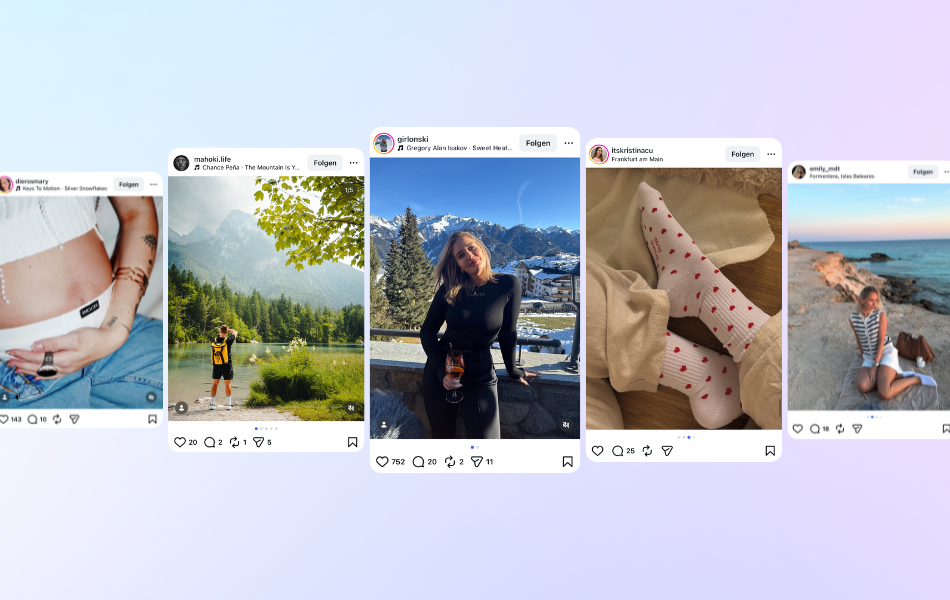
Purelei showed it another way. The jewelry brand built its communication around a Hawaii-inspired lightness as a way of life — not as a marketing buzzword, but as a consistent energy in everything they presented as a brand. Customers began showing how the pieces fit into their lives. Not because they were asked to, but because the brand gave them a mirror in which they recognized themselves.
What these brands have in common is not a tactic or a channel. It’s character. They decided who they are — and they stayed that way. The community isn’t the project. It’s the result.

Community as a Growth Lever: What Follows the Reaction
Community isn’t just a feeling — if you build it right as a brand, it becomes measurable capital. Creators who already know and like a brand convert differently than random influencers you reach through cold outreach. Authentic UGC from your community performs stronger in ad formats than expensively produced brand content – in fact consumers are 2.4x more likely to view UGC as authentic compared to brand-created content. When you’re already showing up organically in conversations, that creates visibility that radiates further in paid placements.
This is why community marketing is getting so much weight in growth strategies right now: because it’s sustainable. Brands with active communities see up to 46% higher customer lifetime value and reduce acquisition costs by an average of 32%. Because trust that people build for each other — through shared experiences — is more robust than any message a brand spreads about itself.
The next step after the reaction is activation. Systematically tracking signals from your community, identifying suitable creators, translating UGC that already exists into ready-to-use marketing assets — that’s where squarelovin comes in. As a platform that helps brands take what’s already alive in their community and turn it into scalable growth. From organic moment to measurable channel.
The Real Question
A community strategy doesn’t begin with a platform choice. It doesn’t begin with an editorial calendar, and not with the question of whether to go with Discord or a closed LinkedIn group.
It begins with an honest answer to a simple question: what would your customers say about your brand if you weren’t in the room?