How Coachella’s satellite events became the most valuable real estate in experiential marketing.
There are two Coachellas. And neither of them is exactly what you think. Coachella satellite events — the brand-hosted, invite-only activations orbiting the main festival — have quietly become the most strategically significant real estate in experiential marketing. But to understand why, you need to understand what happens beyond the polo fields.
The first one you know. A hundred thousand people packed into the Empire Polo Club in Indio, California. Dust storms rolling across the fields. Three stages running simultaneously, pulling crowds in three directions at once. Twelve-dollar waters. Shuttle queues that stretch for half a mile. It’s chaotic, sweaty, glorious — and entirely beside the point for a growing class of brands.
The second Coachella is quieter. It unfolds behind the gates of private estates in Palm Desert, in air-conditioned pop-ups engineered to feel effortless, at curated gatherings where every surface is photographable and every guest is a content engine with six figures of followers. No wristbands. No general admission. You don’t buy your way in — you get invited.
This is where the real action is happening. Coachella is no longer just a music festival. It has become a geographic anchor for a dozen high-stakes brand universes, each running its own programming, its own talent strategy, and its own content pipeline — all orbiting the polo fields without ever requiring a ticket to them.
The Baseline Is Already Steep
A general admission ticket runs upward of $500. Airbnbs hit $2,000 a night. By the time you’ve added flights and logistics, a Coachella weekend can easily top $5,000 per person. The “mass” audience here is already highly self-selected — younger, wealthier, and more culturally connected than almost any comparable gathering.
For a brand, that should already be compelling. And yet, for the most strategically minded ones, even this crowd is too broad.
Which is why they built their own.
Exclusivity on Top of Exclusivity: Revolve, Camp Poosh, and the 818 Outpost
The coachella satellite event ecosystem around Coachella 2026 was, by any measure, more sophisticated than ever. Three events in particular illustrate the full range of approaches brands are taking — and why the model works.
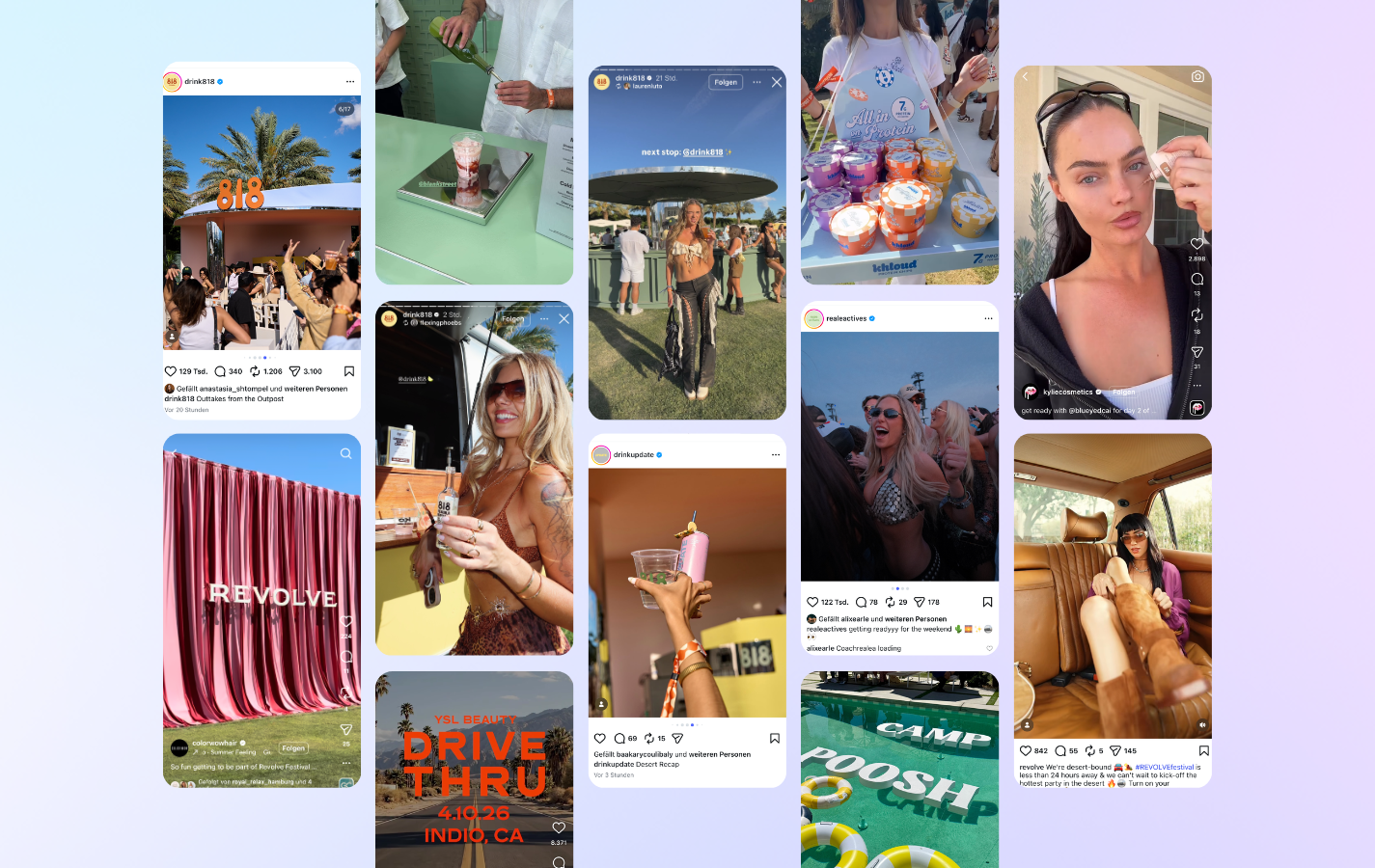
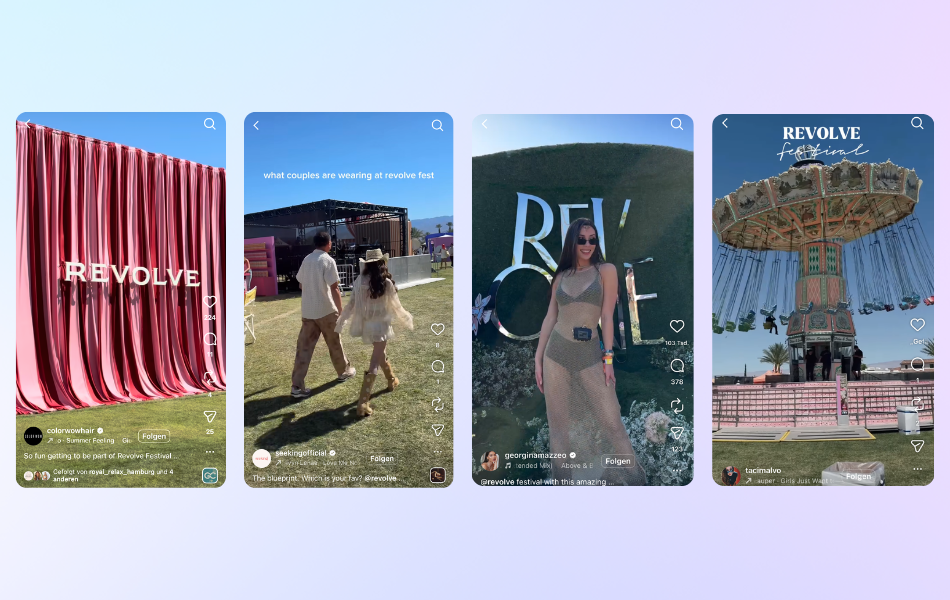
REVOLVE Festival, now in its ninth year, is the most established of the three. Held on April 11 in Thermal, California, the event is explicitly framed around the online fashion retailer’s brand universe. This year’s theme — “The Grand Revivre” — leaned into old-world carnival aesthetics, complete with performers headlined by Don Toliver, supporting sets from Mustard and Kehlani, and a shoppable festival edit curated around trend categories including Western, boho, and cottage core. Brand partners ranged from Patrón to Huda Beauty to Quay sunglasses. The guest list included Teyana Taylor, Charli D’Amelio, Lisa and Jennie from Blackpink, and a rotating cast of creators.
Critically, REVOLVE Festival is not affiliated with Coachella or Goldenvoice. It doesn’t need to be. The festival serves as context, not content. REVOLVE uses Coachella weekend as a cultural moment — a built-in reason for thousands of the world’s most-followed creators to be in the same valley — and hosts an entirely parallel universe tuned to its own aesthetic and customer base. The ticket price is zero. The real price is your follower count.
Camp Poosh, founded by Kourtney Kardashian Barker, returned for its fourth year with a different energy entirely. Where REVOLVE is glossy and maximalist, Camp Poosh plays a wellness card: the Saturday event runs from 1–5pm at a private Palm Desert estate, with a program built around Pilates classes (ClassPass, FS8), beauty stations (SexyHair), a TikTok Shop wellness lounge, and supplement sampling courtesy of Lemme — Kourtney’s own brand. Ashlee Simpson headlined the entertainment portion.
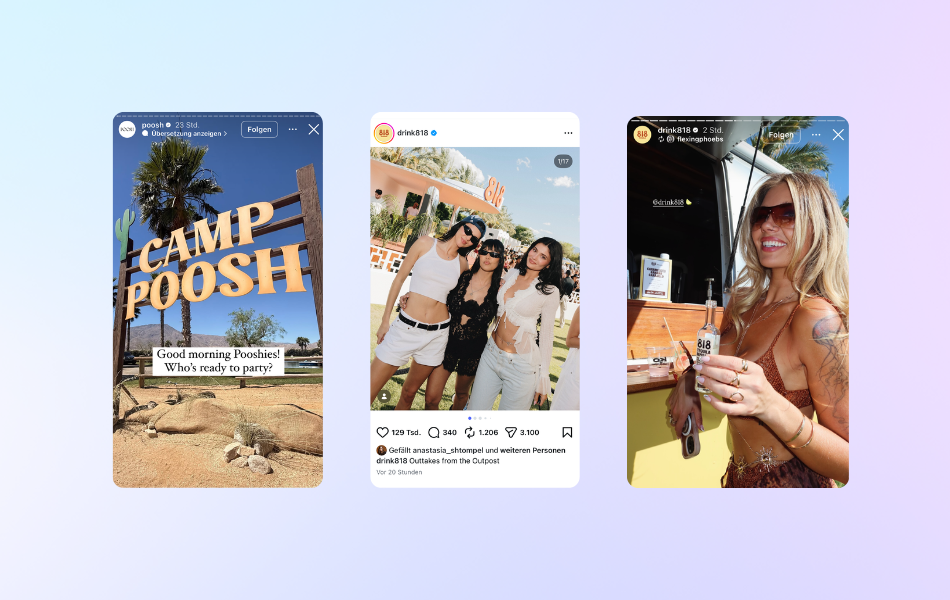
The brand logic at Camp Poosh is almost academic in its clarity. Kourtney Kardashian Barker is, herself, a brand. Poosh is the media platform that extends that brand. Camp Poosh is the live activation that brings Poosh’s content pillars — wellness, motherhood, clean living, luxury-adjacent accessibility — into three-dimensional form, then hands that experience to 500 perfectly curated guests with iPhones. The sandstorm that tore through the venue on April 12 and went viral on TikTok? That wasn’t a disaster. It was, accidentally, the most attention Camp Poosh has ever received.
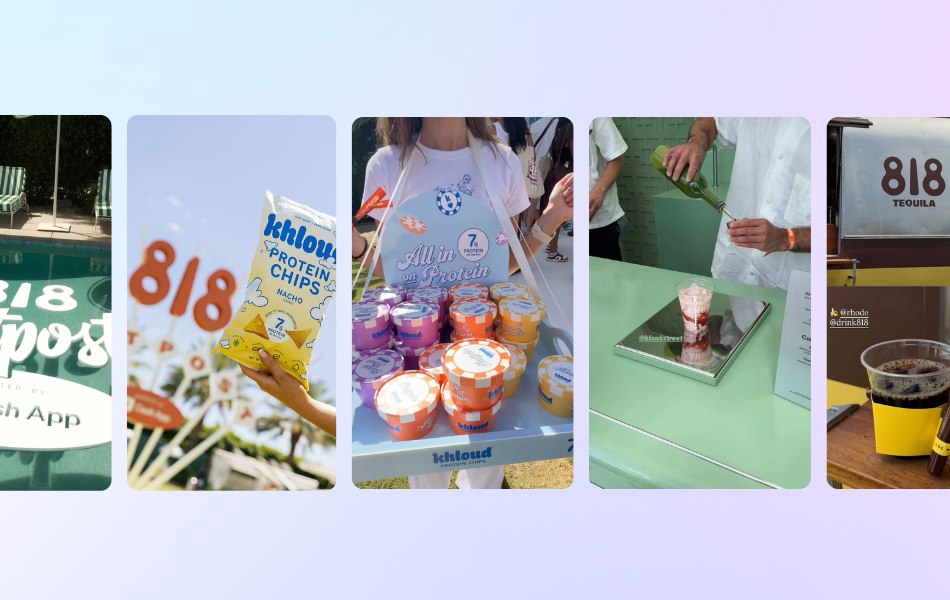
Then there is the 818 Outpost — which is, at this point, arguably the most architecturally ambitious Coachella satellite event in the entire ecosystem. Now in its fourth year, Kendall Jenner’s 818 Tequila brand transformed a private estate in Indio on April 10 into a full brand campus designed around Mid-Century Googie architecture and space-age retrofuturism. Kaytranada headlined. But the venue itself was the real act.
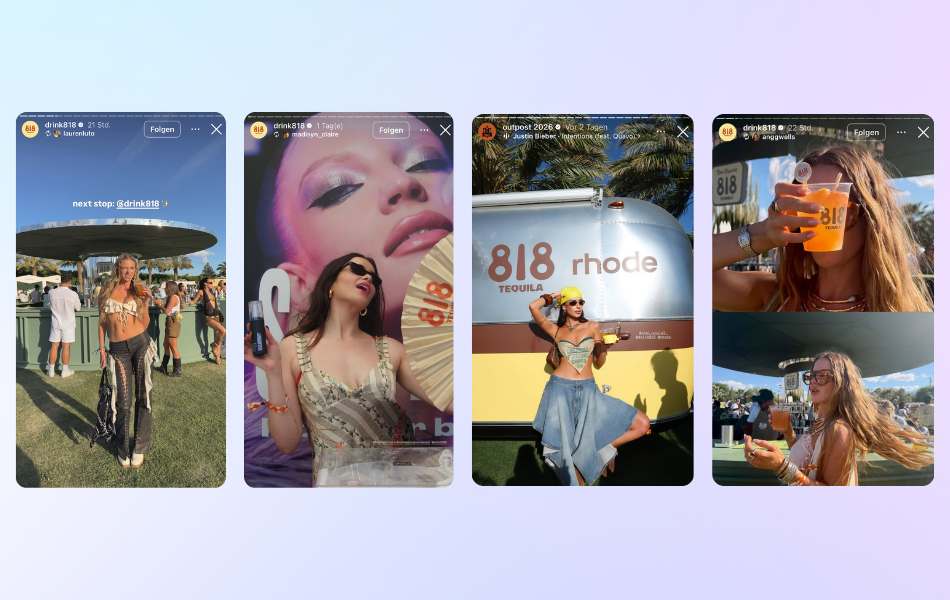
Brand activations included Blank Street Coffee making its West Coast debut — serving matcha and espresso drinks with an 818 twist — alongside Rhode, Salt & Stone, Lemme gummies, HydroJug laser-engraving stations, Snapchat photo booths, Urban Decay, and Kylie Cosmetics. Each partner plugged into 818’s infrastructure: the estate, the crowd, the aesthetic, the content moment. Each walked away with assets they couldn’t have generated independently.
These three are simply the most visible. By 2026, the model has proliferated across the entire cultural spectrum of the valley: medicube, the K-Beauty brand, built its “Glowtel Desert Oasis” activation for the first time this year, signaling that the format has gone global. Gallery Desert House brought the art world into the mix. NYLON House extended the legacy media brand into a physical hosting space. The names change; the playbook is identical.
The Professionalization of the Influencer Era
It would be easy to look at all of this and shrug: haven’t brands always sponsored parties at Coachella? Hasn’t celebrity presence at festivals always generated press?
Yes — but the nature of that presence has changed completely.
The “Boho Coachella” era of the early 2010s was defined by organic celebrity attendance. Vanessa Hudgens in a flower crown photographed by a Getty wire. The appeal was authenticity — or at least its convincing simulation. A celebrity at Coachella was there because she wanted to be. The brands she happened to be wearing were lucky beneficiaries of editorial coverage.
What’s happening now is categorically different. It is a content factory with a festival as its backdrop. Brands fly in creators with pre-negotiated deliverables. Lookbooks are provided. Posting windows are scheduled. A macro-influencer arriving at the 818 Outpost has, in many cases, already agreed to a minimum of two Stories, one Reel, and a grid post with specific tag and disclosure requirements. The “candid” moment is a production value.
This isn’t cynicism — it’s professionalization. The economics are simply too attractive for any other outcome. Consider REVOLVE’s numbers: at last year’s Coachella, the brand generated $7.67 million in Earned Media Value from organic posts alone — not a single paid placement. On top of that, Coachella-tagged content consistently outperforms comparable posts without the festival context by 12.65% in views and 18.16% in likes. The desert doesn’t just concentrate the right people; it makes everything they post perform better.
A single creator with two million engaged followers, posting authentic-feeling content from a private desert estate, can generate reach that would cost ten times as much to replicate through traditional media buying. The brand gets to borrow not just the creator’s audience, but their credibility — their sense of personal taste and endorsement. The creator, in turn, gets access to events and experiences that reinforce their own positioning.
It is a symbiosis that has matured into an industry.
The Brand-Within-a-Brand Ecosystem
The most sophisticated evolution in the 2026 Coachella satellite event landscape isn’t the events themselves — it’s the sub-activation model pioneered most clearly by the 818 Outpost.
Think of it as a franchise structure. 818 provides the anchor: the venue, the coolness infrastructure, the headline talent, and — most importantly — the invitation list. That list is the product. A private estate filled with 500 carefully selected creators, A-list celebrities, and industry tastemakers is the most targeted media buy available to a consumer brand.
Smaller brands don’t build their own estates. They can’t. The cost of venue rental, talent booking, production, and logistics for an event of this caliber runs well into the millions. Instead, they pay or partner to plug into 818’s existing infrastructure. Blank Street Coffee doesn’t need to build brand awareness from scratch at Coachella — it debuts at the 818 Outpost, where its audience is already assembled and already primed by the surrounding aesthetic to receive something cool and new. Salt & Stone doesn’t need to buy a billboard in the Coachella Valley — it puts its sunscreen into the hands of 500 people who will photograph themselves using it, in golden hour desert light, and post it to an audience of millions.
This is hyper-targeting at its most elegant. Instead of broadcasting to 100,000 festival-goers with inconsistent purchase intent, brands are reaching 500 “super-spreaders” — people whose content decisions have outsized influence on consumer behavior. The math changes entirely. Impressions become irrelevant; what matters is the quality of the content moment and the authority of the person creating it.
Does Coachella Mind?
The relationship between Goldenvoice — Coachella’s longtime organizer — and the Coachella satellite event ecosystem is more nuanced than it might appear.
On paper, the events compete. Camp Poosh runs from 1–5pm on Saturday. The 818 Outpost occupies all of Friday. REVOLVE Festival is an all-day event. Every hour a creator spends at a private estate is an hour they’re not on the polo fields. The most photographed faces at Coachella weekend are, increasingly, photographed somewhere other than Coachella.
But the relationship has a symbiotic dimension that makes outright conflict unlikely. The satellite events bring people to Indio who might otherwise skip the desert entirely. A-list celebrities who would balk at the logistics of a mass-market festival weekend — the wristbands, the crowds, the lack of air conditioning — will fly to Coachella Valley for a private estate with a curated guest list, world-class catering, and a personal stylist on call. Once they’re there, they’re in the ecosystem. Some of them walk through the festival gates. All of them contribute to the cultural gravity that keeps Coachella the most valuable festival real estate in the world.
Without the luxury of the outposts, the cool crowd migrates elsewhere. With them, the desert remains the center of the cultural calendar for two weekends every April.
The Future of Experiential Marketing
What we’re watching at Coachella is the early shape of something larger: the replacement of the campaign with the ecosystem.
Traditional experiential marketing thought in events. You build one activation, you measure footfall, you calculate cost-per-impression, and you move on. The satellite event model thinks differently. It builds a relational infrastructure — a recurring gathering with a consistent identity, a returning guest list, and a deepening set of brand associations — that compounds in value over time. The 818 Outpost in its fourth year is worth more than it was in its first, not because the production has scaled, but because its reputation has. Brands that partner with it are borrowing from an established cultural bank account.
The implications extend well beyond Coachella. The same logic is appearing at Art Basel, at SXSW, at the Super Bowl weekend — anywhere that cultural gravity concentrates the right audience in one place. The question for marketers is no longer “how do we get into the festival?” It’s “how do we build the parallel universe that makes the festival irrelevant?”
What This Means for Smaller Brands
The crucial insight is that this mechanic scales down. You don’t need Kendall Jenner and a seven-figure budget to apply the principle. What smaller and emerging brands can take from the Coachella satellite event playbook is the structural logic underneath: find the cultural moment where your audience is already gathering — whether that’s an industry conference, a local subculture, or a niche community event — and build something within it that’s designed well enough that the people there document it voluntarily.
A skincare brand that opens a small, perfectly curated pop-up for 50 selected creators during a local fashion week is following exactly the same logic as the 818 Outpost — just without the private jet. The difference isn’t budget; it’s clarity. Who are we, who are we inviting, and what should they experience? When those three questions have a consistent answer, the content takes care of itself — because it doesn’t look like advertising. It looks like a recommendation.
And the answer, it turns out, comes down to one deceptively simple principle: don’t create an advertising environment. Create a space people actually want to be in — and want to share. The brands succeeding at this aren’t asking “how do we get our logo in front of influencers?” They’re asking “how do we build something worth documenting?” The 818 Outpost, Camp Poosh, and REVOLVE Festival don’t feel like marketing. They feel like the best party of the weekend. That feeling is the product. Every post that follows is the dividend.
In the attention economy, a photograph of a celebrity cradling a matcha cup at a private Palm Desert estate is worth more than a sixty-foot billboard on Interstate 10. The desert is no longer just for music. It is the world’s most expensive showroom — and the brands that understand this are building accordingly.